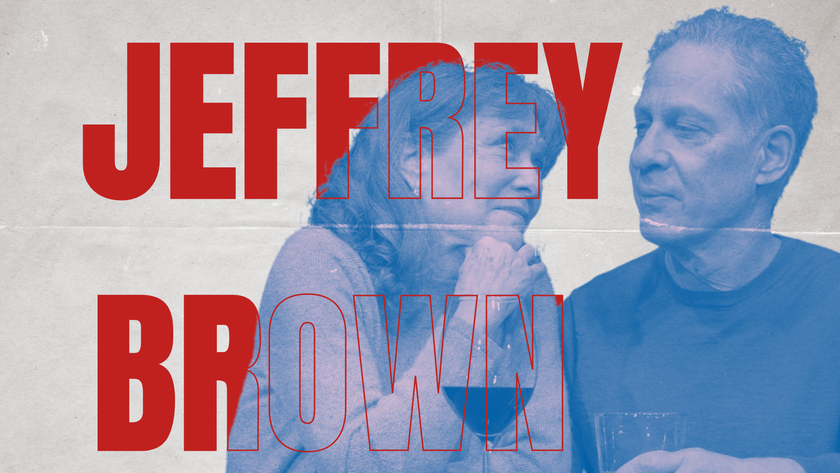
There’s a moment in Still, the new play opening March 20 at Rolling Bay Hall, when the audience is taken into a hotel room. Two people. Thirty years of unsaid things. And a political divide that has already cracked families, friendships, marriages across Kitsap County and everywhere else. “It doesn’t get much more intimate than that in theatre,” Jeffrey Brown says. “And I think some of that would be lost in a larger venue.”
He means Rolling Bay — the snug, black-box space in the valley, physically close enough to the stage that there’s nowhere to hide, for the audience or the actors. But he could just as easily be talking about everything his new company, Sharp Tack Productions, is trying to do: get close. Get real. Make theater that touches something people are already carrying.
Sharp Tack was founded in the fall of 2025 by Brown, actor Ruth Bookwalter, and Terace Yeatts — three veterans of the Kitsap theater community who saw a gap in an already-rich scene. Not a gap in ambition or talent, but in what was being made. “We’re not competing,” Brown says. “We’re hoping to contribute to enriching the pool.”
The name they chose is doing a lot of work. Sharp tack is a sailing term — a change in direction. But a tack is also something that holds something up, pins it there for examination. Or something that pierces. “The work we choose should have the potential to change the direction of an audience’s point of view,” Brown says. “Or hold up a mirror to reflect or comment on society. Or pierce through the noise to provide clarity or insight in often cacophonous times.”
The guiding question Brown and his co-founders ask before committing to a play is deceptively simple: Why here? Why now?
Still, by playwright Lia Romeo, answered both. The play follows Mark and Helen, former lovers reuniting for a drink thirty years after their breakup — and they find themselves on opposite sides of a political divide that has reshaped everything around them. “This situation has touched so many of us,” Brown says. “How the fissures and pressures in our society and politics today can explode into our most intimate personal relationships — partners, parents, children — often changing them forever.”
The play also spoke to Brown’s own instincts as a writer. His short play A Nip in the Autumn Air placed a married couple over pre-dinner drinks, their life together rising to the surface in rumor, truth, and unresolved grievance. The DNA is recognizable. “I’ve always been intrigued by the presentation of self in the world versus the internal world we all live in,” he says. “Masks, secrets, revelations, the lies we tell ourselves and others. In ‘Still,’ the revelations rock the relationship to its core.”
Brown has been writing, directing, and acting in Kitsap theater for nearly a decade. In Still, he’s doing only one of those things — performing opposite Bookwalter, under the direction of Sabrina Fiander. It turns out that being on the receiving end of someone else’s script has its own kind of education.
“As I was working on learning lines, I was also admiring what Romeo did with character development, pacing, dialogue, story-telling, and dramatic arc,” he says. “I learned a lot about playwriting by being an actor in this play.”
Fiander shaped the production with what Brown describes as a rare quality: genuine empathy with the actor. “A respect for the rehearsal process, and an openness to experimentation. Her guidance has made Ruth and I better, deeper, and more genuine in our interpretations of our characters.”
Preparing for a play built on intimacy meant building trust before the script ever demanded it. Brown and Bookwalter spent hours developing backstories, arriving to the room already knowing, in some sense, who they were to each other. “We felt committed to ‘go there,’” Brown says, “because it’s really the crux of the story.”
Bainbridge has given Brown community and proximity to talent. But he’s clear-eyed about what it is and isn’t. “It can have a monolithic, cloistered feel,” he says, “so my imagination is fed by experiences I have had throughout my life, people I have met along the way, and my social concerns.” He doesn’t need the island to be his subject. It’s enough that it’s his home.
“Theater is a live art form,” he says. “Its immediacy is what gives it its power. In an age where technology seems to be replacing humans, theater remains an experience that cannot be outsourced.”
He hopes people leave Still with empathy — for each other and for themselves. And maybe, he adds, “a bit of poignancy about the fragility of our most treasured relationships.”
Still opens March 20 at Rolling Bay Hall, 10598 NE Valley Road, Bainbridge Island, and runs through April 5. Tickets are $20 ($18 seniors) at sidequeststage.com.
In His Own Words
The Full Conversation
Ahead of Sharp Tack's debut, Kitsap Creative sent Jeff Brown a set of questions. The profile above is drawn from his answers. Here is that conversation in full, in his own words.
Sharp Tack Productions is new — can you tell us about how it came together? Who else is involved, and what was the spark that led to actually forming a company?
Sharp Tack was formed in the fall of 2025 by Jeff Brown, Ruth Bookwalter, and Terace Yeatts because we saw an opportunity to expand the already robust theatre scene here. Kitsap County is richly endowed with many community and regional theaters and production companies, producing a wide spectrum of theatrical fare – musicals, children's theater, classics, newer work, comedies and dramas – to name a few. This theatrical art scene is also home to a depth of talent not found in many places – actors, directors, playwrights, set, light and sound designers, musicians and singers. I feel lucky to be living in such a rich theatrical environment.
So, why another production company? Part of the answer is that even with the plethora of options available, there are still plays not being produced, and theatre artists wishing they could experience more opportunities on stage. We hope to produce the kind of work that delights audiences and attracts theatrical talent. And what kind of work might that be? We will look for newer work, along with established work perhaps not often produced. This might include workshopped scripts, premieres, shorter-runs, along with shows that haven't been seen in these parts in a while.
Our name hints at the kind of work we want to produce: "Sharp Tack" is a sailing term meaning a change in direction. A tack can also be something that holds something up (for reflection or contemplation), or that pierces something (illusions or hearts). Thus, the work we choose should have the potential to change the direction of an audience's point of view. Or hold up a mirror to reflect or comment on society. Or, to pierce through the noise to provide clarity or insight in often cacophonous times. And always, works that can reach and touch our audiences' hearts.
You've been part of the Kitsap theater community as a playwright through Island Theatre's Ten-Minute Play Festivals. How did that writing background lead you toward producing and performing in a full-length production?
In addition to writing for TMPF, I've acted in and directed full-length and shorter works, and enjoyed both. Participating in the Festival introduced me to many talented actors, writers and directors - some of whom I have cast in plays I've directed. Producing seemed the natural next step since that involves choice of material, venue, artists, and engagement with the audience. Ultimately, producing is participating at a level that can offer fellow artists additional opportunities in theater, and audiences another option.
Your own short play 'A Nip in The Autumn Air' — a retired couple over pre-dinner drinks, tallying up a life in rumor, truth, and unresolved grievance — shares real DNA with 'Still.' Do you actively seek out material that resonates with your instincts as a writer?
Fascinating question. I've always been intrigued by the presentation of self in the world versus the internal world we all live in. Masks, secrets, revelations, the lies we tell ourselves and others, the myths we live by. In "Nip" all of this is portrayed within a marriage that contains both truth and hidden emotions. In "Still", the revelations revealed within the play rock the relationship to the core. So, yes, my interests as a writer were mirrored in "Still". And I think that each of my pursuits - acting, writing, directing - inform the others by providing their own perspectives to the process of making theater.
What drew you specifically to 'Still' by Lia Romeo? What made it the right play to launch Sharp Tack with?
One guiding principle of Sharp Tack is "Why here/ Why now?". We want to think about why a particular work makes sense for our potential audience at this time. "Still" is focused on something many of us have been coping with for last few years - how the fissures and pressures in our society and politics today can explode into our most intimate personal relationships - partners, parents, children - often changing them forever. The question at the heart of "Still" is whether love can survive even when the person we thought we knew is on the "other side" of the political divide. This situation has touched so many of us, so we felt a Kitsap audience might enjoy wrestling with it in this poignant, funny, and at times, explosive play.
What's it like being directed by Sabrina Fiander? What does she bring to the room?
Sabrina has a unique skill set which reflects her immersion in many aspects of theater and years of experience. Perhaps one of her strongest skills is empathy with the actor - a respect for the rehearsal process, and an openness to experimentation. Her guidance and "notes" have been spot-on, and have made Ruth and I better, deeper, and more genuine in our interpretations of our characters and their relationship to each other. We feel lucky to be working with her on this project!
You're acting in a play you didn't write. As a playwright yourself, do you find the writer brain switching on — noticing the architecture, deconstructing the choices?
Absolutely! As I was working on learning lines, I was also admiring what Romeo did with character development, pacing, dialog, story-telling, and dramatic arc. I learned a lot about playwriting by being an actor in this play.
'Still' lives entirely in the space between two people — what's said and what isn't, who they were and who they've become. How do you prepare for material that intimate and that quiet?
Ruth and I spent hours developing back stories, and shared these with each other. When we began rehearsing we were operating on a good foundation of knowing "who each other were" - as each character would in a story involving former lovers. Over the long rehearsal process, we developed a trust in each other as actors and individuals so that we felt comfortable with the intimate moments, as well as the rageful moments. We felt committed to "go there" because it's really the crux of the story. As for the "quietude", Sabrina's consistent guidance about remembering to "take the beats", even to elongate them, helped immensely in creating the necessary moods.
What's the bigger vision for Sharp Tack Productions? What kinds of stories do you want to tell, and what kind of audience are you hoping to build on Bainbridge?
"Still" encapsulates the "why here/why now" principle, and going forward we will look for other works that intrigue, captivate, challenge, and entertain. We hope to offer new works, some premieres, some workshopped pieces. We hope to continue to work in smaller, more modular venues like Rolling Bay which are ideal for connecting with audiences on a visceral level due to their "black box" feel.
Rolling Bay Hall is wonderfully intimate as a venue. How does the physical space shape a production that's already so emotionally close-quarters?
Rolling Bay feels ideal for this show. The actors are very physically close to the audience which facilitates an intimacy appropriate for a show about intimate relationships. Spoiler alert: we take the audience into the hotel room where Mark and Helen have just re-connected - it doesn't get much more intimate than that in theatre, and I think some of that would be lost in a larger venue.
Bainbridge already has a rich theater ecosystem — BPA, Island Theatre, Lesser Known Players. What does it feel like building something new inside a community that already cares deeply about live performance?
Great theater and great art thrive in rich ecosystems. Artists learn from each other, collaborate, see each others' shows and the percolation can be exponential. We're not competing, we're hoping to contribute to enriching the pool, providing additional experiences for artists and audiences alike.
Has living on Bainbridge shaped your creative voice in any tangible way? Does the place show up in what you write or the roles you choose?
Bainbridge is a special place and I treasure living here. I have met amazing people who have enriched my life. Having said that, it can have a monolithic, cloistered feel, so my imagination is fed by experiences I have had throughout my life, people I have met along the way, and my social concerns. Bainbridge can be supportive, but I haven't written specifically about it. In my choice of roles I am probably looking at roles that expand my knowledge of the human experience.
What do you hope audiences carry out of 'Still' with them — not the theme or the message, but the feeling?
Empathy - for each other and for themselves. Recognition - of themselves or people whom they love. Perhaps a bit of poignancy about the fragility of our most treasured relationships.
Is there anything else you'd like people to know — about the show, about Sharp Tack, about yourself? The floor is yours.
Theater is a live art form – its immediacy is what gives it its power. Every performance is a unique, shared experience between the performers and the audience. In an age where technology seems to be replacing humans, theater remains an experience that cannot be outsourced. Actor and audience are engaged in the moment in a fresh, lived experience with the potential to transform, entertain, and enlighten. We hope folks come out to see a performance where intimacy in personal relationships is front and center, and hope that it sparks conversations about their own challenges, loves, frustrations, and joys.